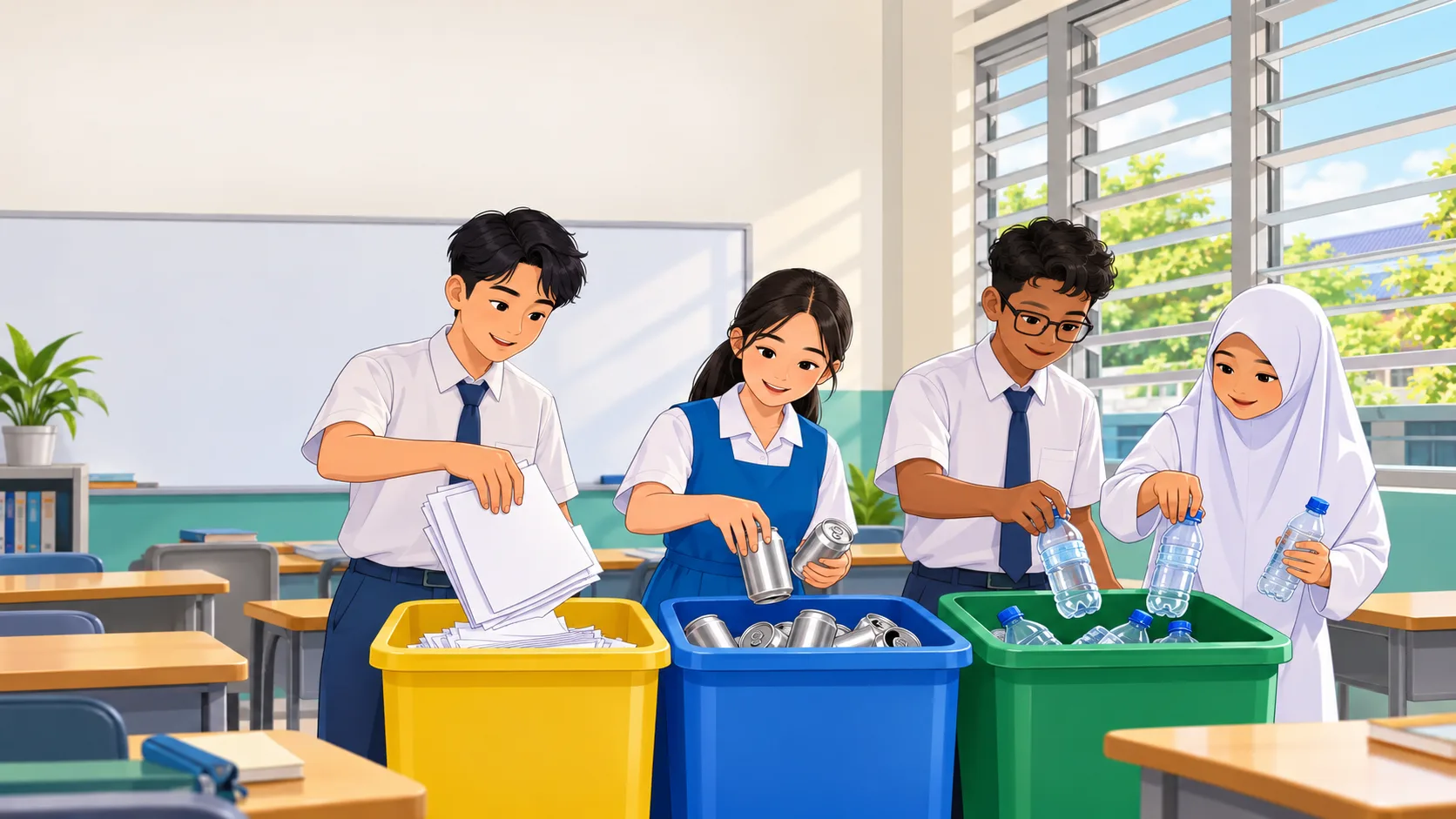
Intended use
Use this collection for concept visuals, worksheets and teaching slides. It suits a clear single learning focus rather than a text-heavy poster. For diagrams or visuals explaining curriculum facts, attach the relevant subject source or DSKP extract. Verify factual accuracy and cultural representation before use.
Variables
{{CONCEPT}}— learning concept or situation.{{LEARNER_LEVEL}}— for example Year 3 or Form 1.{{SETTING}}— a relevant Malaysian setting, not random decoration.{{STYLE}}— for example flat, textbook or paper-cut illustration.{{ASPECT_RATIO}}— 16:9 for slides, 4:3 or 1:1 for worksheets.
Prompt 1 — concept illustration
Create an {{ASPECT_RATIO}} educational illustration for {{LEARNER_LEVEL}} learners explaining {{CONCEPT}} through one clear scene in {{SETTING}}.

Use a clean {{STYLE}} style, readable shapes, clear contrast and a controlled number of objects. Show the concept’s relationship or sequence visually without long text. If labels are needed, preserve blank space so the teacher can add them later. Depict clothing, architecture, plants and objects appropriate to contemporary Malaysia without stereotypes.

Avoid logos, official emblems, flags, generated text, celebrity likenesses, copyrighted characters, distorted anatomy, duplicate objects, clutter and elements unrelated to the learning objective.
Prompt 2 — worksheet visual set
Create a consistent set of four small illustrations for a {{LEARNER_LEVEL}} worksheet about {{CONCEPT}}. Give each panel one main subject, a white or minimal background, clean outlines, high contrast and space below for a teacher-added label. Use plausible everyday Malaysian objects and settings. No text, numbers, logos or decorative frames.
Suggested workflow
- Generate without final text.
- Check concept accuracy against curriculum materials.
- Review anatomy, objects, clothing, location and cultural details.
- Add labels in an accessible design tool.
- Provide alternative text explaining the visual’s learning function.
Limitations and responsible use
Generated illustrations may contain factual errors or stereotypes. Do not use a fictional image as historical or scientific evidence. Avoid generating identifiable real learners, and never upload student photographs without proper permission and a valid processing basis.